

What Does “Good” Look Like in a Mature Data-Driven Culture?
Contents
- The Data Operating Model for a Data-driven Culture: A Living Ecosystem
- Why It’s a Journey – Not a Big Bang
- The Role of the Chief Data Officer (CDO)
- Final Thoughts: From Ambition to Achievement
“Data-driven culture” is more than a buzz term; it’s a strategic imperative. Yet despite investing heavily in platforms and tools, many organisations still struggle to realise the promised value. Why? Because true transformation requires more than technology, it demands a cultural shift.
Nobody disputes that data and AI carry enormous value potential. However, substantial investments often yield underwhelming benefits when they’re not paired with broader organisational change. As Gartner points out, becoming a data-driven enterprise is not about technology alone; it’s about embedding data literacy and insight into every business decision. Similarly, McKinsey highlights that organisations must “hard-wire” data into their processes to remain competitive by 2025.
Being data-driven means that decisions at every level are guided by reliable evidence derived from data, not by hierarchy, instinct or the loudest voice. In practice, this involves:
- Clear business questions translated into measurable hypotheses.
- Well-governed data that is timely, accurate and ethically sourced.
- Analytical methods that quantify uncertainty and bias.
- A culture that rewards acting on insights, even when they challenge intuition.
It is as much about behaviour as it is about dashboards.
An increasing number of forward-looking businesses are recognising this shift. They understand that achieving meaningful, measurable value requires more than just implementing a data or AI platform. It demands an operating model rooted in a truly data-literate culture.
But what does that culture look like in practice?
The Data Operating Model for a Data-driven Culture: A Living Ecosystem
As with any organisational transformation, delivering measurable, long-term value from data requires rethinking the entire operating model. According to Gartner’s Data & Analytics Trend Report, the future lies in designing flexible “data products” and composable architectures—not just tech stacks. That means looking beyond systems to the way people, processes, technology, and data work together.
At Data Curious, we frame this as a four-layer ecosystem:
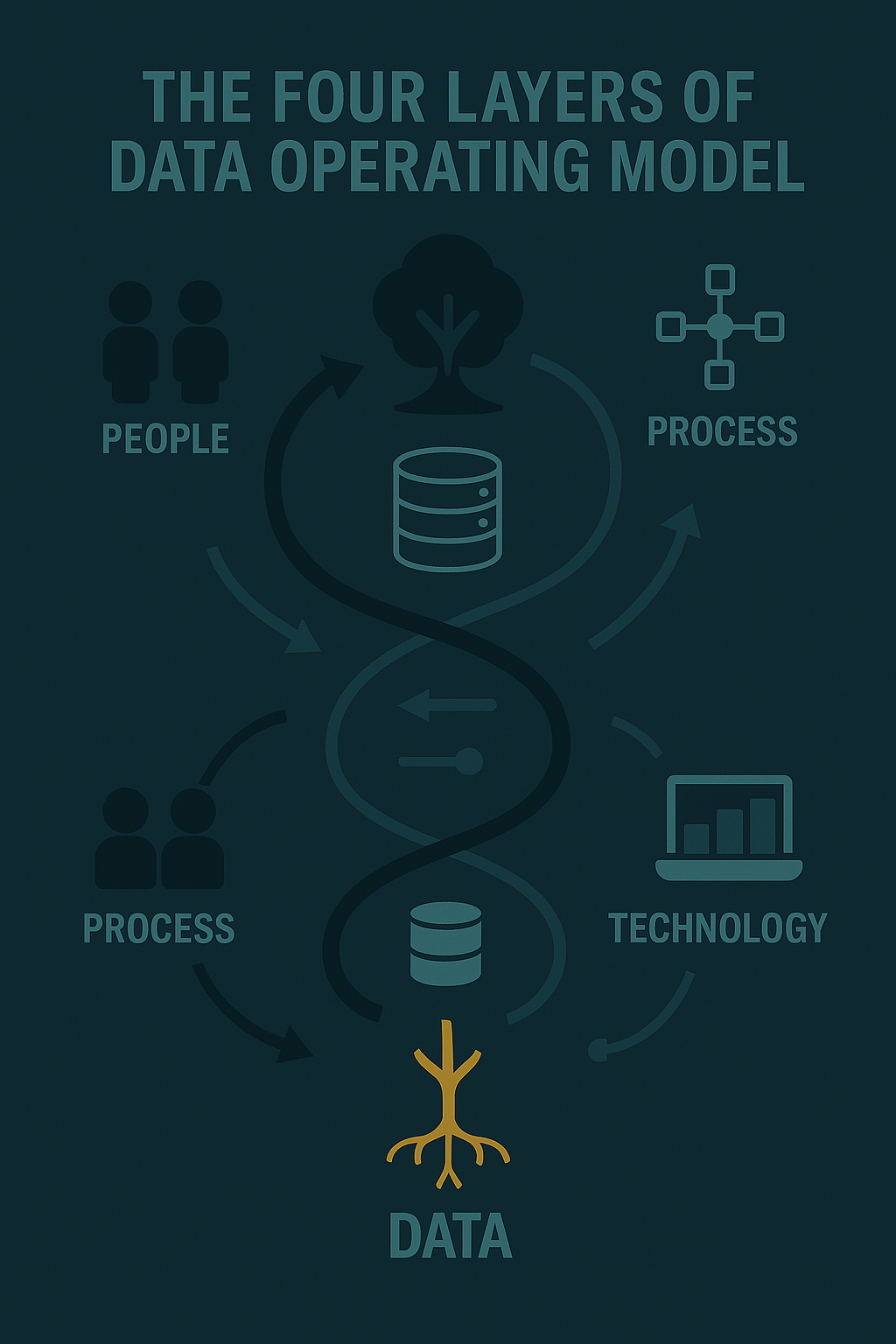
🔹 People
Technology doesn’t create value—people do. Whether they’re analysts or executives, employees must be empowered to use data confidently and responsibly. McKinsey’s research highlights that democratising data access and investing in data literacy are critical to transformation.
Furthermore, an effective and business-aligned organisation is required to serve the needs of business decision makers. Data Architects, Data Engineers, Data Analysts and Data Scientists are some of the key roles that have critical roles to play.
🔹 Process
There are three essential types of data processes:
- Data Management – Maintaining data quality across its lifecycle: from creation to deletion.
- Data Governance – Ensuring privacy, security, and compliance (e.g., GDPR) through clearly defined protocols.
- Data Value Delivery – Establishing reliable, repeatable services to support decision making.
Processes must be streamlined, documented, and wherever possible, automated.
🔹 Technology
Enablers, not silver bullets. A mature tech stack might include:
- Data platforms and analytics tools
- Data catalogues and quality tools
- MDM and AI/ML platforms
Gartner stresses that the most successful enterprises are shifting from monolithic systems to modular, metadata-rich ecosystems that can flex with change.
🔹 Data
The raw asset—lifeblood of every modern business. But data is only valuable when it’s clearly defined, trusted, and accessible. That requires strong data architecture, lineage tracking, and shared understanding.
What does “good” look like in a mature data-driven culture?
| Dimension | Characteristics of maturity |
| Leadership & governance | Board-level sponsorship, a Chief Data Officer with budget authority, data ethics council, KPIs for data value creation. |
| Data literacy | >80 % of staff complete role-appropriate data training, self-service analytics adoption measured and rising, storytelling with data embedded in management reports. |
| Processes | Standardised data-quality SLAs, automated data lineage, data products have product owners and roadmaps, continual improvement loops after each release. |
| Technology | Modern cloud platform, real-time streaming where needed, governed access through catalogues, MLOps pipelines, cost monitoring. |
| Metrics & incentives | Decisions evaluated against data-driven targets, teams acknowledged for learning from A/B tests, incentive schemes include data-quality scores. |
| Ethics & compliance | Privacy impact assessments baked into delivery, transparent AI explainability documentation, independent audits. |
| Collaboration | Cross-functional squads pairing domain experts with data engineers and analysts, open data office hours, internal communities of practice. |
When these elements work in concert, data becomes part of daily conversations and drives demonstrable financial, operational and customer-experience gains.
Why It’s a Journey – Not a Big Bang
McKinsey warns that many organisations approach data initiatives as one-off deployments and get stuck in pilot purgatory. The reality? Building a data-driven culture is an ongoing transformation. Here’s why:
- A “big bang” approach is often too expensive, risky, and misaligned with fast-evolving needs.
- Data literacy and expectations evolve as teams begin to explore what’s possible.
- The pace of AI and data tech innovation demands continuous adaptation.
Instead, organisations need flexible roadmaps that evolve the model incrementally delivering value and insight at every stage.
The Role of the Chief Data Officer (CDO)
Gartner reports a sharp rise in organisations appointing CDOs as transformational leaders, not just data stewards. Their role is to align data initiatives with business strategy, lead cross-functional change, and embed a data-first mindset across the enterprise. A mature operating model won’t succeed without this kind of top-down commitment.
Final Thoughts: From Ambition to Achievement
Building a genuinely data-driven organisation isn’t a one-off project; it’s a long-term, strategic initiative. It takes senior sponsorship, a compelling business case, and an adaptable operating model that ties together people, processes, technology, and data into a cohesive engine for growth.
The critical first step is to establish a data strategy that has strong buy-in from the boardroom downwards. This must set out the vision for how data will enable the organisation to achieve its strategic objectives and the target data operating model that will deliver this. Then it must describe a series of business cases that will deliver business value whilst also enabling investment in the operating model.
As McKinsey notes, by 2025, winning organisations will embed data into every interaction and decision. That’s not just a technical challenge—it’s a cultural one.
Is your organisation on the journey? Or stuck at the starting line?
I’d love to hear your perspectives:
- Have you hired a CDO to lead your transformation?
- How are you evolving your data ecosystem?
- What roadblocks are you encountering as you strive for measurable value?
Let’s start the conversation. Because becoming data-driven isn’t optional, it’s foundational to the future of work.
Haydn Durrant is Data Curious.
Further Reading & References
- Gartner. “Roadmap for Data Literacy and Data-Driven Business Transformation.” 2023. Link
- Gartner. “Top Data & Analytics Trends for 2025.” 2025. Link
- McKinsey & Company. “The Data-Driven Enterprise of 2025.” 2022. Link
- McKinsey & Company. “Charting a Path to the Data- and AI-Driven Enterprise of 2030.” 2023. Link
Leave a Reply